Mimi and the Grands

Educating Through Multiple Intelligences

Teaching Short Vowels-The M. I. Way (Conclusion)

In the first part of this series, I gave lesson ideas for teaching short vowels to my grandsons using Linguistic, Spatial, and Interpersonal strategies. In this post, I will explain my lesson plans for the other five intelligences: Bodily-kinesthetic, Naturalist, Logical/mathematical, Intrapersonal, and Musical.

As a reminder, I planned the units of study with an eye to modifying the various activities according to the readiness of each grandson:

  • Six year old Tigger had learned the short vowels in kindergarten, but I wanted to give him a good review before he started first grade in September. With Tigger, I would concentrate on short vowel sounds that were found in the middle of words (medial sounds) and review blending them with initial and ending consonants.
  • Kona, 4, already recognized all the uppercase and lowercase alphabet letters and had started to pick up quite a few consonant sounds. I decided he might be ready to learn about short vowels at the beginning of words. Possibly I will try medial short vowel sounds, blending sounds, and word families later on in the year.
  • Tahoe, 2, would not be ready to learn short vowel sounds, but I knew I could modify the lessons so his main focus would be on letter recognition and vocabulary development in the lessons.

I highly recommend using at least one activity from each intelligence, but don’t feel like you need to do all of the activities I’ve listed. I always over plan so I have list of choices, and then decide which activities best fit the needs of my grandsons. I taught the short vowel unit of study over a six week time period, but I am still doing a few activities each week with them as a review.

Bodily-Kinesthetic (Body Smart)

My grandsons are very bodily-kinesthetic so I like to have many of these activities planned for them.

Driving to the Vowel Sound(Tigger and Kona) I used the picture cards I created from magazines and old workbooks that Tigger had completed. Then I taped a different short vowel letter to the top of the boys’ toy cars. The idea is to have the grands “drive” their short vowel “car” to the pictures that begin with the short vowel sound.
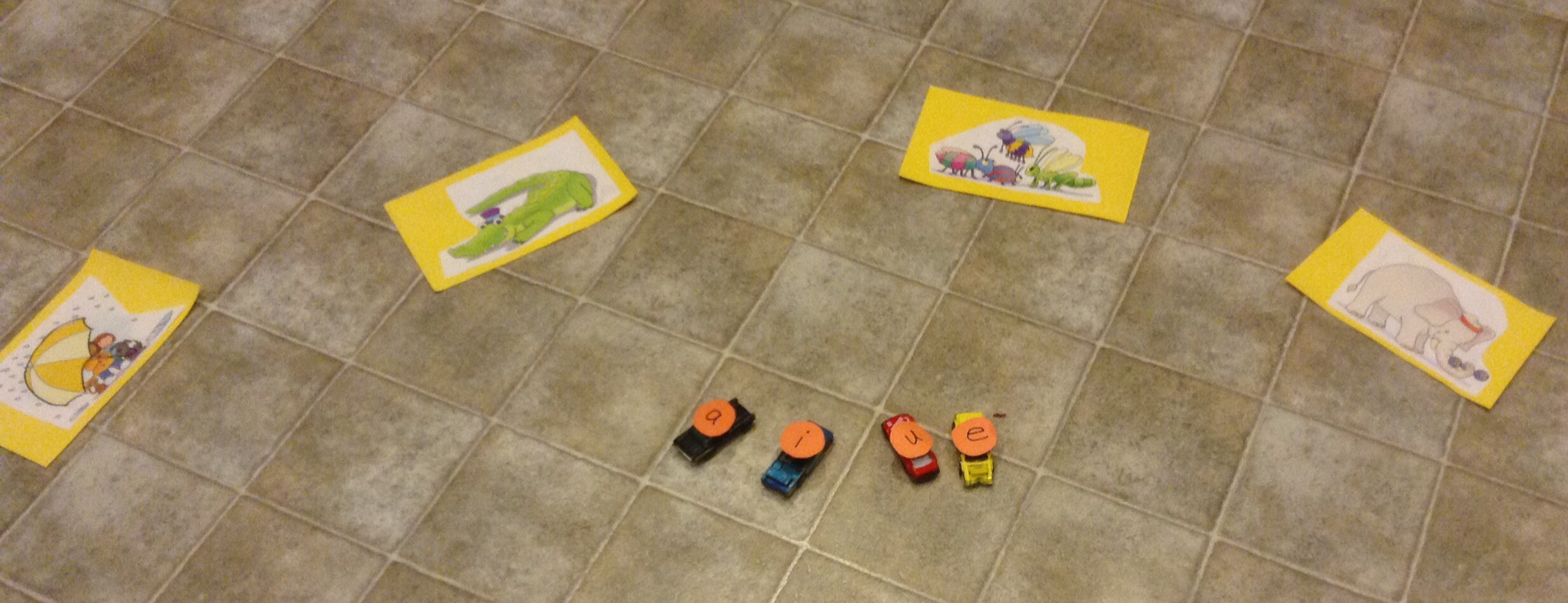
 

I utilized the grands' love of toy cars to make this matching game.
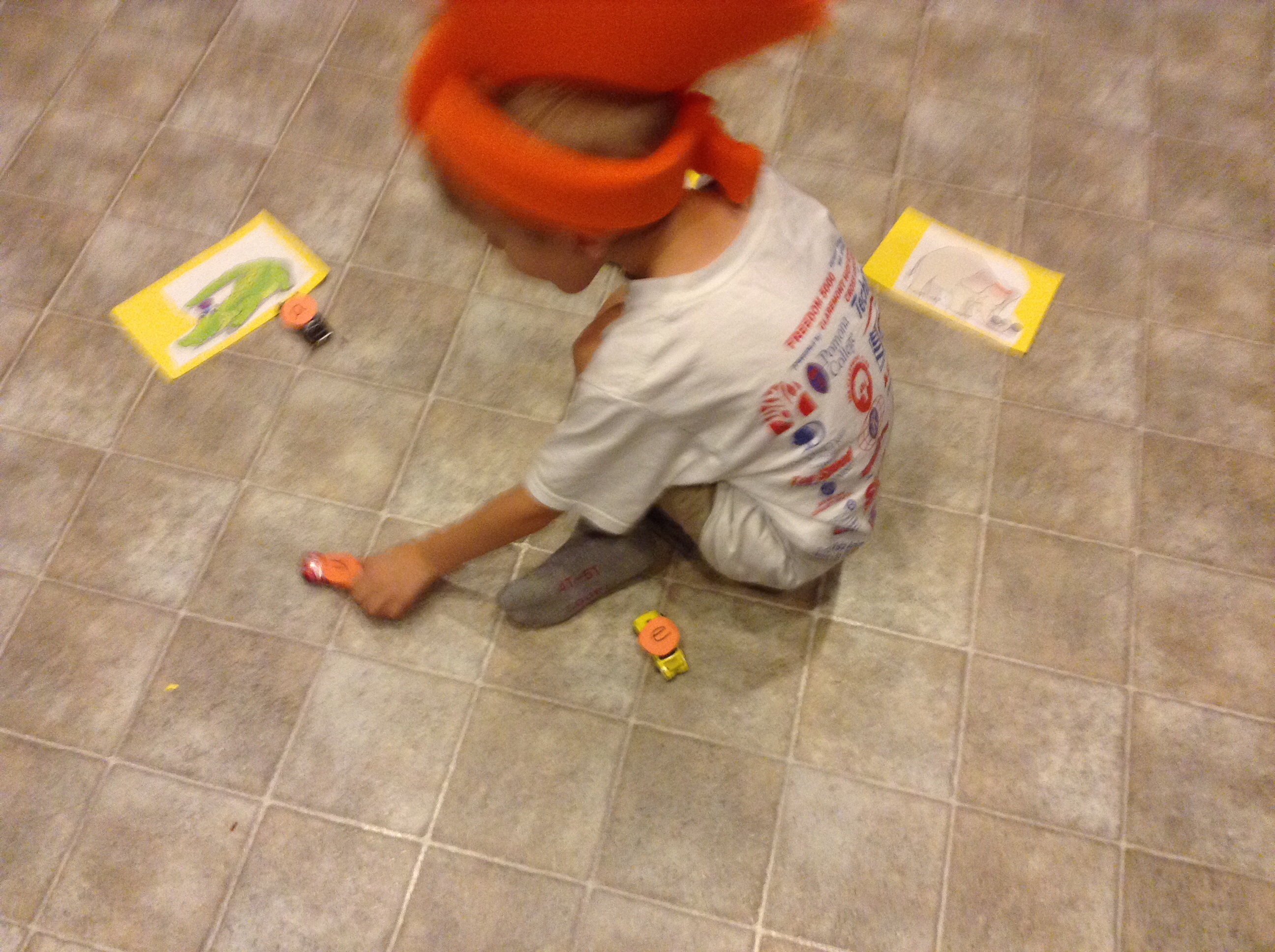
I utilized the grands’ love of toy cars to make this matching game.

I taped the vowel letters on the grands' toy cars.

I taped the vowel letters on the grands’ toy cars.
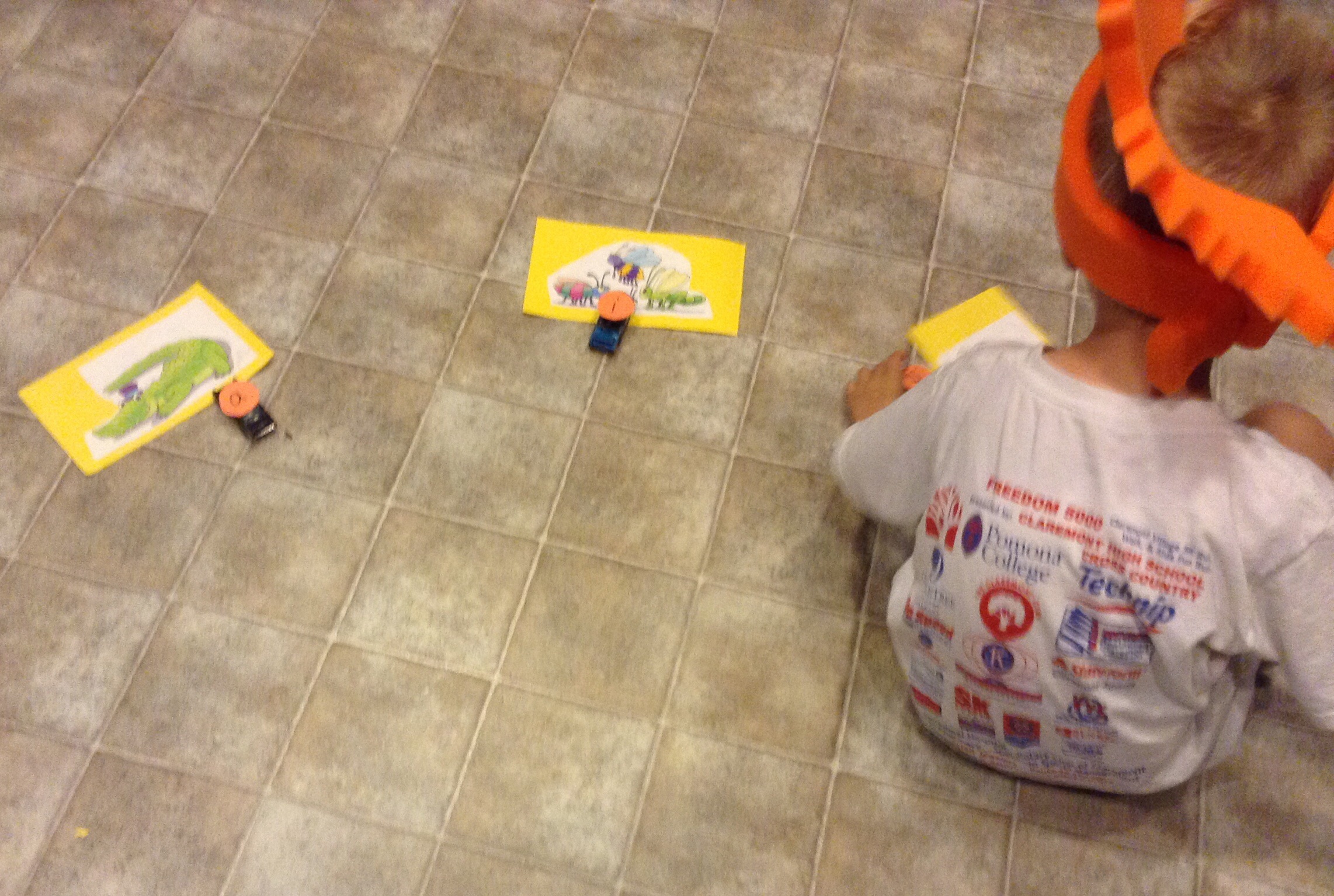
Kona easily matched the "toy cars" with the picture cards I made.

Kona easily matched the “toy cars” with the picture cards I made.

Pantomimes- (All the grands) Pantomime is basically telling a story through movement. To help my grandsons learn how to pantomime, I usually did these with the boys. As they became more confident, the older ones attempted their own pantomime:

  • short a: eating an apple, moving like an alligator
  • short e: hatching from an egg, walking like an elephant
  • short i: moving like an inchworm
  • short o: putting shoes on an octopus,
  • short u: swimming under water, tossing something up in the air

For more movement ideas, look at these links:

http://www.1plus1plus1equals1.net/2008/04/teaching-short-vowels/

http://kidsactivitiesblog.com/25870/physical-fitness

Find the Treasure- (All the grands)-This activity combines bodily-kinesthetic and spatial intelligences. I had a new building set for the grands, but instead of just giving this gift to them, I used it as a way to review the short vowels. I divided the set into five parts,  placed each set of  pieces in a baggie, and then hid them. Next I made a treasure map (spatial intelligence) using short vowels in the “clues” and the grands had to run around the house and backyard (bodily-kinesthetic) to find their “treasure”. Tigger had to read the words with short vowels on the map and I helped with the words he didn’t yet know. Kona had to tell me which short vowel sound he heard, and Tahoe guessed the name of the letter. Here are some ideas for clues that contain short vowel sounds:

  • under the table
  • on the bed
  • up the playset ladder
  • on the desk
  • where eggs are kept
  • next to the apple tree
  • in the toybox

The inspiration for this activity I found at this link:

http://www.playdoughtoplato.com/2014/10/20/jake-neverland-pirates-treasure-hunt/

Hiding Short Vowels(Tigger and Kona) I use the picture cards I made from magazines and old workbooks for many activities, including this one. I gave each grandson a card for each short vowel and asked them to hide them and remember where they place them. They could be hidden anywhere in the house. When that was completed, each grandson was given a letter (written on an upcycled bottle cap). They were told to find the picture that started with the short vowel sound made by the letter they were given. Since these boys are very competitive, they raced through the house to find their hidden card. I repeated this with each short vowel sound until all the picture cards were found. It was a good workout for them, and they wanted to play the game again.

Bath time Short vowels- (All the grands)- I have not done this idea yet, but when I do, I will use short vowel letters (or words with short vowels in the medial position for Tigger) instead of sight words. Basically you put the letter of each vowel sound on circles made from craft foam. Each child has a net and as you call our the vowel sound, the child has to scoop up the correct foam piece. Here is where I found this idea:

http://www.coffeecupsandcrayons.com/bath-time-sight-words/

Relay Race-(Tigger and Kona) Again I will use the picture cards I created and the bottle caps with vowel letters written on them. To play, I will put two picture cards for each vowel at one end of the yard. At the other end I will give each grandson one bottle cap with a vowel letter they have to match with a picture card. They will race to the end of the yard to find the correct card and return to me. Then I will give them the second vowel letter to find and they will again race to retrieve the correct picture. I will do this until all the pictures have been matched correctly.

  Naturalist intelligence (Nature Smart)

Field trips(All the grands)-This is a great time of year to visit apple orchards and practice the short vowel sounds. We recently went to a local apple orchard that also is attached to a Nature Conservancy wilderness area. All the grandsons had a blast collecting sticks and acorns to make the letters of the short vowels. We discussed the vowel sounds as we explored the area including: apple trees, red ants, sticks, pumpkins, insects, etc. Field trips to zoos, beaches, botanical gardens, and parks are wonderful places to explore living things with short vowel sounds in their names.

Nature Letters (All the grands) Even in their backyard or local park, the grands love to make the letters of the short vowels out of leaves, twigs, in sand, dirt, mud, gravel, or any other items they find in the natural environment. Here are some ideas from another website:

http://www.sugaraunts.com/2014/09/decodable-reading-with-nature-letter.html#.VEvFfVeI2f4

Scavenger Hunt-(All the grands) I made a list of plants, animals, and other items that could be found in the grands’ backyard or neighborhood for each short vowel. I gave the grands some picture cards to help them with a few ideas, but sometimes you come across other words to discuss during the hunt. Included in my list were words that started with the short vowel sound, or words with the short vowel sound in the medial position. Here are some ideas I  had of living things to look for in our local environment:  liquid amber tree, bird egg, cat, dog, twig, ants, apple tree, sun, walnut tree, lizard, mud, sand, insects, bugs, rocks, elm tree, evergreen tree, animals, apple tree, under rocks, and olive tree.
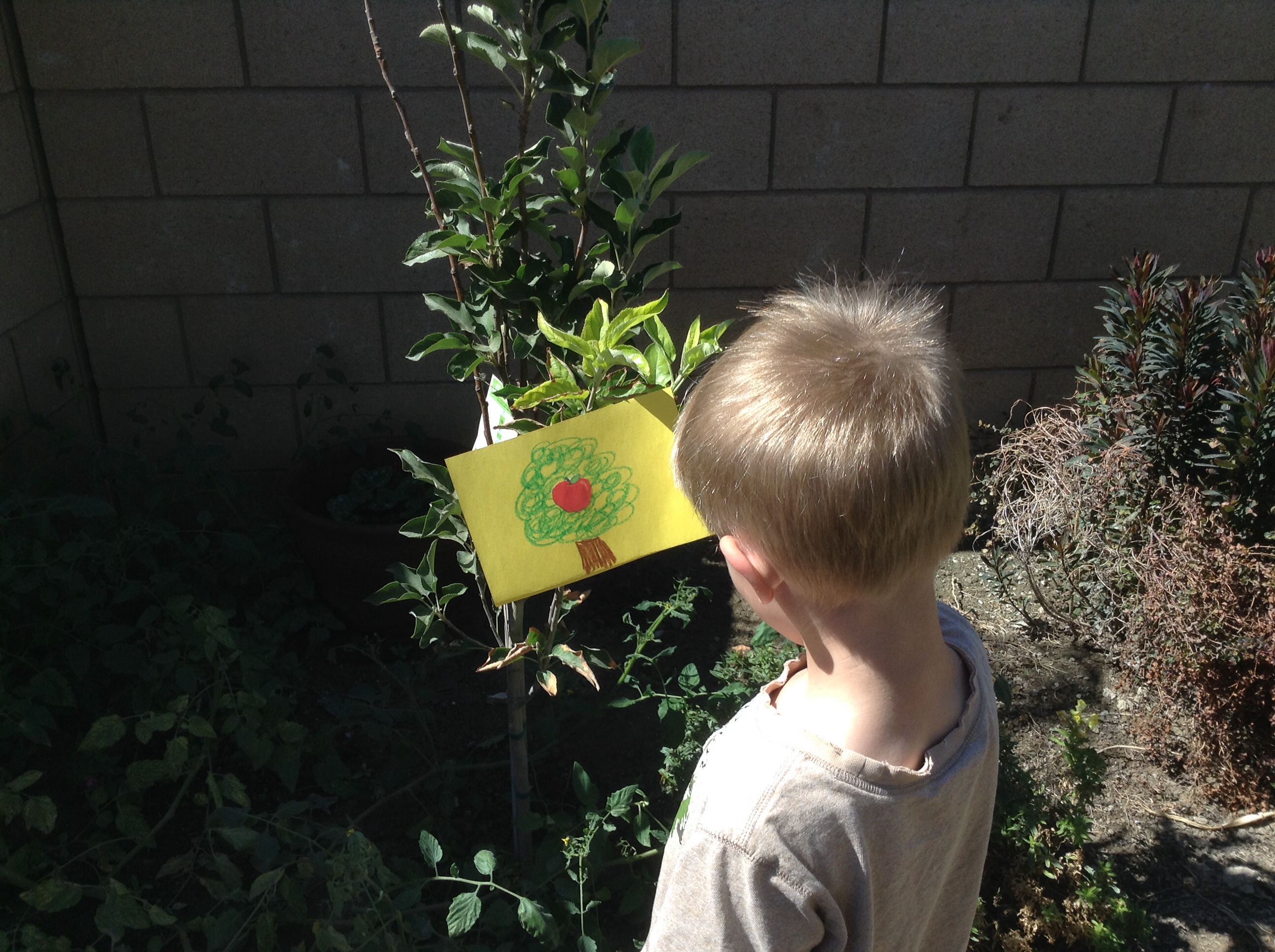
Kona explores words that begin with the short a sound with an outdoor scavenger hunt. Pictures help him in his search.

Kona explores words that begin with the short a sound with an outdoor scavenger hunt. Pictures help him in his search.


Logical/Mathematical Intelligence (Number/Reasoning Smart)

Counting activities:

There are so many ideas for counting, but here are a few:

  • seeds in apples
  • number of apples in a bag or on a tree
  • eggs left in egg carton before and after making scrambled eggs
  • legs on insects
  • sides on an octagon or arms on octopus
  • spokes on an umbrella 
  • number of ingredients in a favorite recipe

Measuring:

Since “inches” starts with a short vowel sound, use an inch ruler or measuring tape to measure other items with short vowels including: apples, eggs, stop signs (which are octagons), umbrellas, etc. Here is a neat idea about making playdough inchworms to measure:

http://www.teachpreschool.org/2011/11/playdough-inchworms/

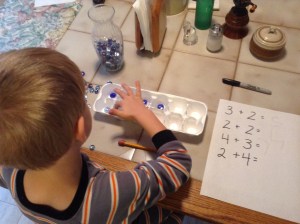
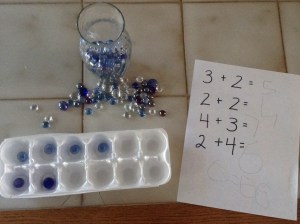
Egg carton math:  (All the grands) There are lots of ways a simple egg carton can be used for math activities. Here is one that my grandsons have done. Using an empty egg carton, I created an addition activity for Tigger and Kona. I used two different colors of any small item (buttons, pom poms, plant gems, etc.) and placed some of each color in the separate egg carton areas.  Then they counted all the items to see how many items were in the egg carton altogether. Since Kona and Tigger can write their numbers, I also had them write their answers on paper. (Instead of addition problems for Tahoe, he counted the items in the egg carton.) Besides doing the math activity, discuss the short vowel sounds found in egg carton, buttons, pom poms, and plant gems.

I found some more fun math activities using egg cartons here:

http://www.notimeforflashcards.com/2013/09/egg-carton-math-by-teach-preschool.html

Octagon Search- (All the grands)-Although all the grands have seen octagons many times, I gave them a picture of one and had them find octagons around the house or neighborhood (for example a “Stop” sign is an octagon).

Intrapersonal Intelligence (Self Smart)

Independent reading- (All the grands)-Besides the books I get from the library each week specifically for the vowel sound we are studying, there are plenty of books already in the boys’ library that they can enjoy whenever they want. Their parents have made sure they have plenty of picture dictionary books, which Tahoe especially enjoys at his age. He loves to point to the pictures and say the words he knows. The other boys enjoy retelling the story by looking at the pictures, and Tigger likes to find the words he knows (which are usually words with short vowels in the medial position).
Exploration Bins-(All the grands) Using a box or plastic bin, place items that begin with the short vowel sound inside and cover with rice, beans, or macaroni. For example, place plastic eggs, small toy elephant figures, and little Elmo dolls in a bin for the “e” short vowel. The child uses their hands to find the items in the bin. Afterwards, discuss with the child each item and the connection to the short vowel. Ask them which one was their favorite and why they chose that item. For more information on this idea, check out this website:

 http://www.themeasuredmom.com/letter-e-dig-find-box

Short Vowel App-(Tigger and Kona) I downloaded this new app from one of my favorite websites and introduced it to Tigger. He enjoyed it and can use it by himself now. I will be using this with Kona also.

http://thisreadingmama.com/short-vowels-word-study-app/

Musical Intelligence (Music Smart)

 Finger plays and songs-(All the grands) Wow! There are so many resources to locate songs and finger plays. If you just type in the words “short vowel songs” into a search engine, there will be dozens of songs and fingerplays from which to choose. I have found other songs by typing in the short vowel word (such as “apple”, “octopus” or “umbrella”) when I want to find a song about a particular word. Here are the ones I found recently:

short a: http://www.kididdles.com/lyrics/johnny-appleseed.html  or http://www.alphabet-soup.net/dir2/applesong.html

short e: http://www.canteach.ca/elementary/songspoems99.html

short i: http://ccplonline.org/kids/songs4tots/insectsallaround.html

short o: http://www.dltk-teach.com/alphabuddies/songs/o/orangeoctopus.htm

short u: http://www.letsplaykidsmusic.com/the-umbrella-song-rainy-day-songs/

Create your own fingerplays -(All the grands) Just take a familiar fingerplay song and use short vowel words in place of the other nouns. When the grands were babies, I would sing this song to them although I used the noun “Einsteins” in it. Obviously, that word didn’t work when I taught short vowels, so I came up with other words beginning with each short vowel. For example:

“One little, two little, three little otters,

Four little, five little, six little otters,

Seven little, eight little, nine little otters,

Ten little otter pups!”

To take this a step further, I will try to have the grands suggest short vowel words to replace “otter” in this example.

Create your own songs-(All the grands) I like to create my own songs, so I used the tune to “Mary Had a Little Lamb” and adapted it for each short vowel sound. Here are the lyrics for the short “a” sound:

“The short vowel “a” goes ah, ah, ah,

ah, ah, ah,

ah, ah, ah,

apples, ants, and alligators,

start with ah, ah, ah.”

I followed the same pattern with the other short vowels. I changed the fourth line in each song as follows:
The short vowel e: “Elmo, eggs, and elephants”
The short vowel i: “igloo, inch, and iguanas”
The short vowel o: “otter, on, and octopus”
The short vowel u: “under, up, and umbrella”


Using multiple intelligence strategies, such as the ones I have put in this unit of study, I have found my grandsons to be very engaged in learning. And because they are doing these activities with their “Mimi”, we are having some very special bonding time. By making sure I use at least one activity from each intelligence, I am increasing the probability that the grands will retain the main points of the lessons.

As for the progress of my grandsons, Tahoe is beginning to recognize some alphabet letters, although his favorite letter of the alphabet right now is “O”. His receptive and expressive vocabulary is rapidly increasing. Kona is doing so well with the short vowel sounds, I have begun working with him on blending one short vowel with one consonant. I am also working with him on the consonant sounds he hasn’t yet mastered, using strategies similar to the ones I used for the short vowels. Tigger is seven weeks into first grade, and he is not having any problems with his reading homework. (I interpret that as a good sign.) I can tell when he reads with me that he is able to sound out words with his short vowels very well. Time for me to plan another unit of study using multiple intelligences.

I hope these ideas have motivated you to think about multiple intelligences when you are planning an activity for the children in your care.
3 Comments »

Multiple Intelligences in Your Home Part 8

Does your child wonder how things work? Do your children like to count their toys or organize them into categories? These would be indications of their logical-mathematical intelligence.   This intelligence is also called “number smart” because it usually involves a thought process using symbols or numbers.

I can see my grandsons using their logical-mathematical intelligences when they play. The children in your care probably do these same things. For example, they count the number of trains they can fit on their train tracks,  the number of grapes I give each of them (to be sure they are each getting their equal share), and they count backwards from ten when they are launching their space shuttle toy. I love their fascination with their mom’s measuring tape. Just the other day,  Kona found the measuring tape and was measuring the height of the chairs by the kitchen counter. (Not sure why.) Tigger is really interested in coins right now, especially since he learned that they can add up to different amounts of money. He likes to play with the pennies, nickels, dimes, and quarters that I keep in his car seat cup holder while I drive him home from school.

LOGICAL MATHEMATICAL

Our logical-mathematical thinking allows us to reason, see patterns, and solve problems. People who are strong in the logical-mathematical intelligence are good at analysis so they are drawn to games that require strategy. Besides being strong in calculations,  they additionally enjoy science experiments, doing puzzles, and solving mysteries. The character Sherlock Holmes was created as a logical-mathematical thinker. Real people who would be considered having strengths in the logical-mathematical intelligence would be Bill Gates or Albert Einstein. As adults, people with strengths in this area might pursue careers such as doctors, scientists, accountants, or detectives.


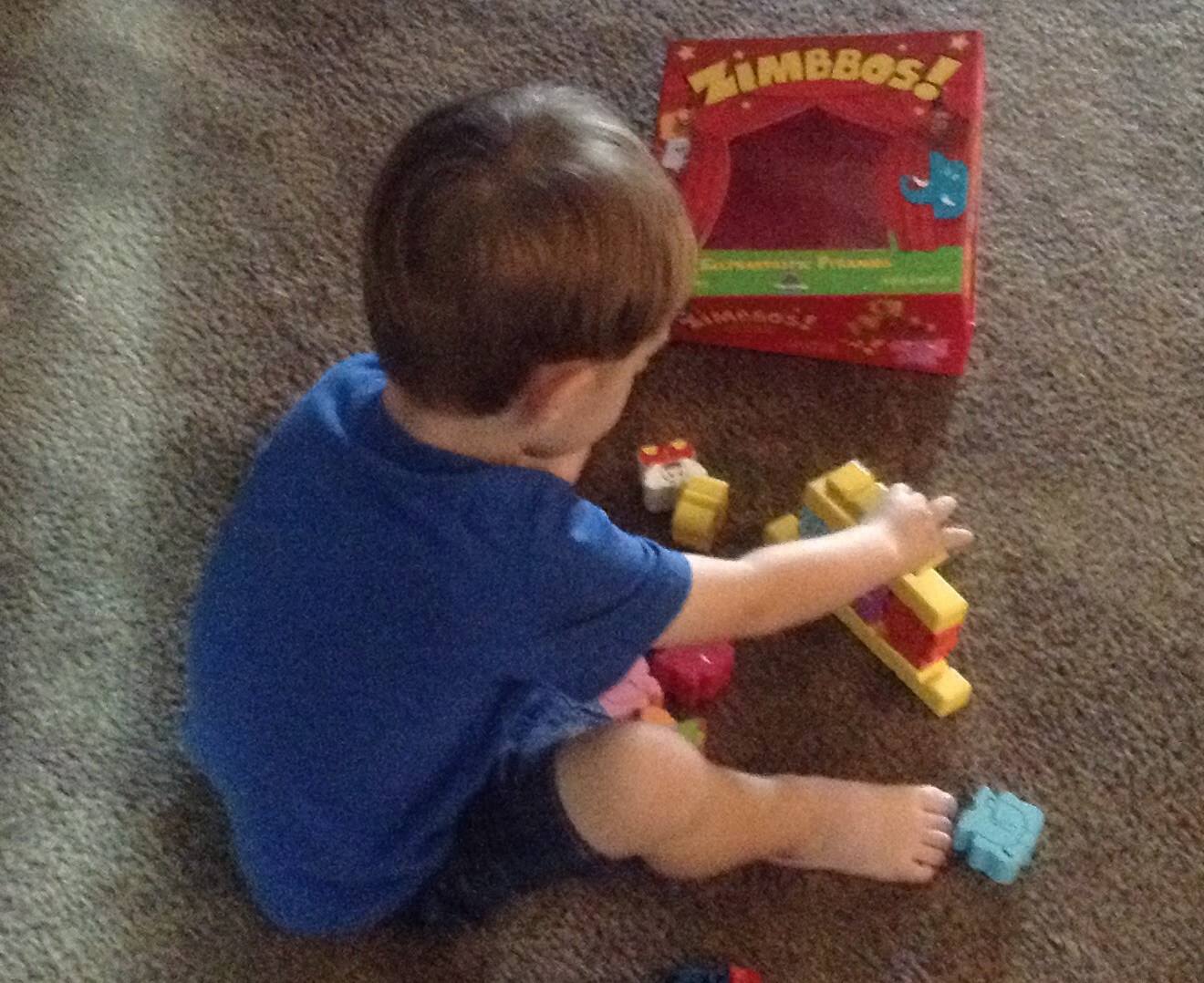
Tahoe can't resist a chance to play this math game by himself. It is best to let children play with the manipulatives for awhile first before teaching them the rules of the game.

Tahoe can’t resist a chance to play this math game by himself. It is best to let children play with the manipulatives for awhile first before teaching them the rules of the game.

To encourage the engagement of a child’s logical-mathematical intelligence, these materials or activities could be provided at home:

blocks (building, attribute, etc.)

iPad apps (such as Counting Caterpillars and Marble Math, Jr.)

board games (math specific or just ones that use dice or numbers to move spaces)

educational children’s shows that focus on math (like Team Umizoomi)

rulers, measuring cups, measuring spoons, thermometers

multiples of any favorite toy (my grands love to count their cars and trains)

geoboards

construction sets

toy clocks

tangrams

having items for them to categorize (buttons, leaves, small toys)

card games (like Go Fish)

dominoes

toy phones, computers, and calculators

shopping ads

science experiments that use numbers (Where is your shadow at 10 a.m. Noon, 2 p.m. and 4 p.m.?)

number lines (could be created with sidewalk chalk on your driveway)

shape sorting toys

creating patterns together (red button, green button, red button, green button, etc.)

cutting food into fractions (apple in halves, sandwich in fourths)

explaining how you  solve a life problem using math (I can get 2 avocados for $1, so I’ll get 4 avocados for $2.)


I hope this series has given you some basic information into the eight intelligences that we all possess, as theorized by Dr. Howard Gardner. In future posts I will show how I apply this theory when planning learning units for my grandsons.

In my next post, I will discuss a different topic; the best books I’ve read over the past few months. Reading is one of my favorite pastimes, other than watching the grands, of course. I hope you’ll be able to relate to the struggles I have had in finding time to read, even in retirement. And if you are looking for a good book to read, maybe one of my recommendations will strike your fancy.

Leave a comment »

Multiple Intelligences in Your Home Part 7

I have chosen to explain linguistic (and logical mathematical) intelligence in my later posts because these two intelligences are the ones that often come to mind when people think of giftedness. Historically, most people were judged on their intelligence according to their ability in reading, writing, and mathematics. Those were the mental capabilities tested in most IQ tests. But according to Howard Gardner’s Theory of Multiple Intelligence, each individual has their own unique blend of the eight intelligences, and can be gifted in other ways. I wanted my readers to explore the other six intelligences first before I discussed the intelligences which may be more familiar to them. This post will provide an explanation of the linguistic intelligence. (By the way, people who read blogs are often strong in this intelligence.)

LINGUISTIC INTELLIGENCE

This intelligence is also known as being “word smart” because it has to do with an acuteness towards language relating to speaking, listening, reading, and writing words. People who have strengths in this intelligence enjoy expressing themselves through words, and may have the ability to learn other languages easily. Often people who are highly linguistic may choose careers as journalists, editors, writers, motivational speakers, politicians, teachers, religious leaders, interpreters, and tour guides.

To encourage children to develop or strengthen their linguistic intelligence, here are just a few materials and activities that you might use:


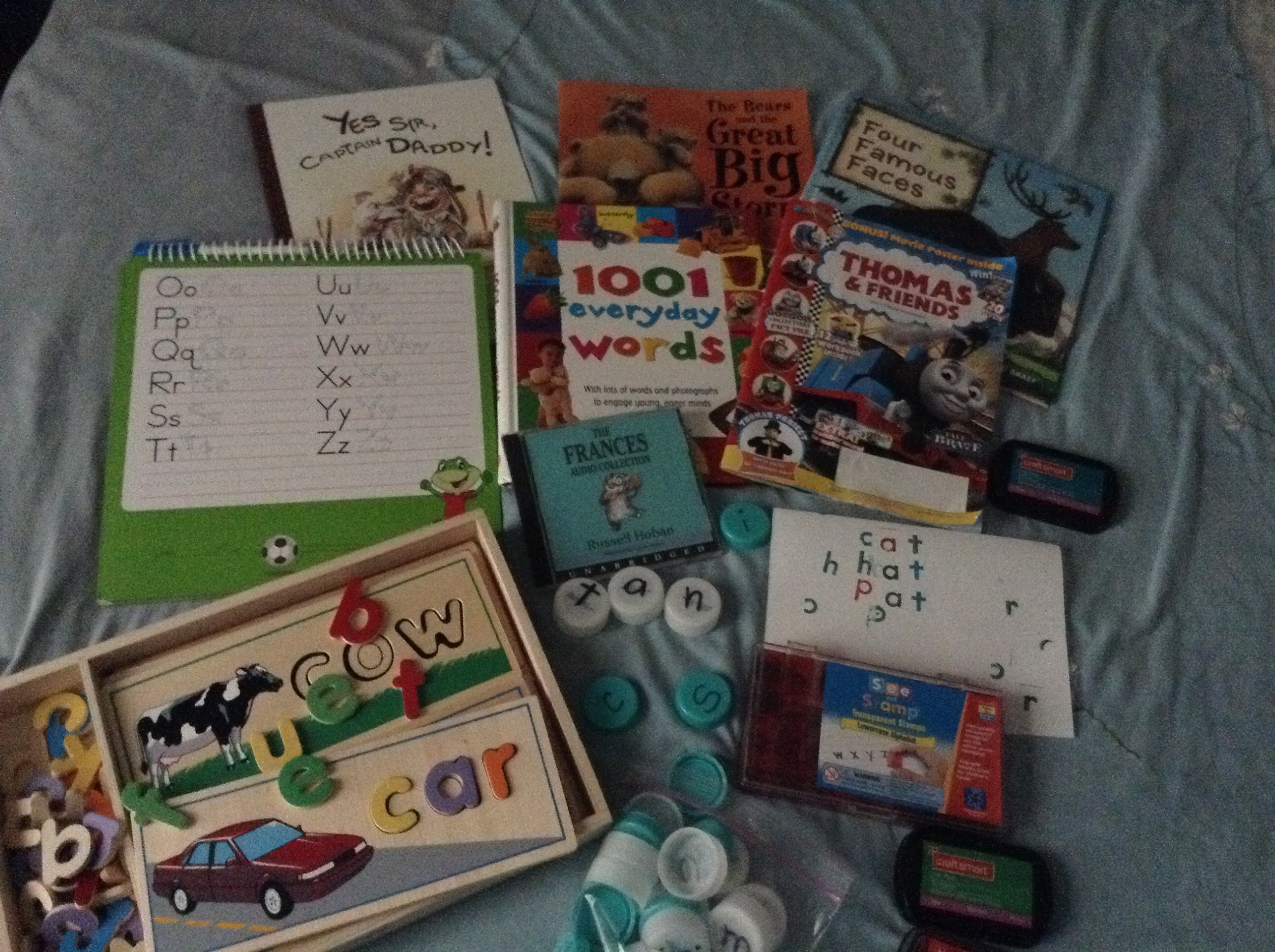
To encourage the linguistic intelligence, it is helpful to have a variety of genres of books, writing materials, and audiobooks.

To encourage the linguistic intelligence, it is helpful to have a variety of genres of books, writing materials, and audiobooks.

lots of children’s books of different genres (fiction, non-fiction, poetry, etc.)

children’s magazines and other appropriate printed material

alphabet puzzles

alphabet magnets

picture dictionaries

letter stamps and stamp pads

writing paper or journals

individual dry erase boards (with dry erase markers and erasers)

iPad apps (such as Reading Raven)

educational children’s show on reading (such as Wallykazaam)

making up stories together

using sign language

family discussions

listening to audiobooks

telling riddles and jokes

singing and/or listening to songs

reading signs when traveling

playing word games like Scrabble and Boggle


I hope this series is providing a nice overview of Howard Gardner’s Theory of Multiple Intelligences. If you would like more information on his theory,  Dr. Gardner has written several books including Frames of Mind: The Theory of Multiple Intelligences (published in 1983 so it does not cover the naturalist intelligence which he added later). 

The last part of this series will cover the logical-mathematical intelligence. Future posts that  currently are in draft form include a long blog on using multiple intelligences to teach short vowels, and a more personal article on how I exercise my linguistic intelligence: some of my favorite books of the past few months.

Leave a comment »

Multiple Intelligences in Your Home Part 6

If you are someone who likes to be a part of a team, loves being around friends, and shows concern for others, you may be very strong in the interpersonal intelligence. The root word “inter” means between or among. So interpersonal intelligence refers to the connections between or among people.

INTERPERSONAL INTELLIGENCE

Children who are strong in this intelligence relate and communicate to people very well. They are usually extroverted, have empathy for others, enjoy persuading others to their point of view, can see other people’s perspectives, and like to be in charge of groups of people.  Mother Theresa and U. S. President Ronald Reagan would be examples of people who were strongly interpersonal.

Keep in mind that people can be both strong in the intrapersonal (self smart) and interpersonal (people smart) intelligences.

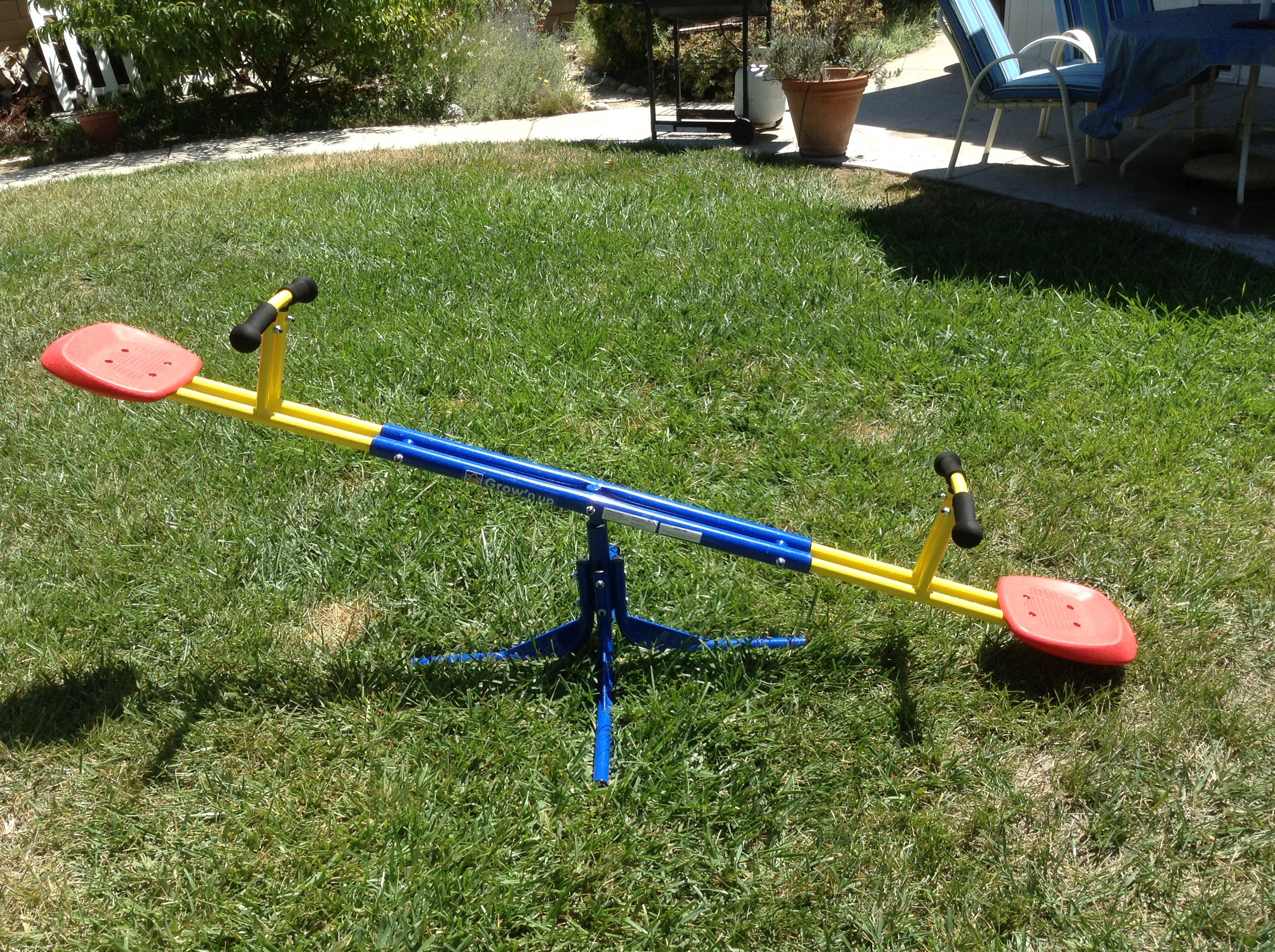
To encourage a child's interpersonal intelligence, have them play with materials or equipment that requires participation by more than one person.
To encourage a child’s interpersonal intelligence, have them play with material or equipment that requires participation by more than one person.


 To support and strengthen a child’s interpersonal intelligence, provide materials and opportunities in which the child needs to engage with others. Here are a few ideas:

play dates

board games (or any game that requires collaboration)

play equipment that requires more than one person

chatting on phone with grandma (or other relatives and close friends)

role playing (tea parties, how to order at a restaurant)

team sports

giving opportunities to lead an activity or group

cooking with adults

volunteering (with an adult)

introducing them to people in the community (neighbors, librarians, grocers, police officers)


The last two posts in this series will give overviews of the linguistic (word smart) and logical-mathematical (number smart) intelligences. Then I will begin a series on applying the Theory of Multiple Intelligences to the teaching of short vowel sounds.


Leave a comment »

Multiple Intelligences in Your Home Part 5

Have you ever craved some “alone” time during the day? You know, just a chance to go off by yourself to think, read, write, or just regroup? Or perhaps you were part of a team at school or work, but would rather have done the project by yourself? This would be your brain engaging the intrapersonal intelligence. Intra means “within or inside” so intrapersonal intelligence is sometimes also called “self smart”. People who are strong in this intelligence are often self-motivated, independent, introverted, organized, goal-oriented, and  enjoy self reflection. They can also have very strong feelings or opinions about things going on around them.

INTRAPERSONAL INTELLIGENCE

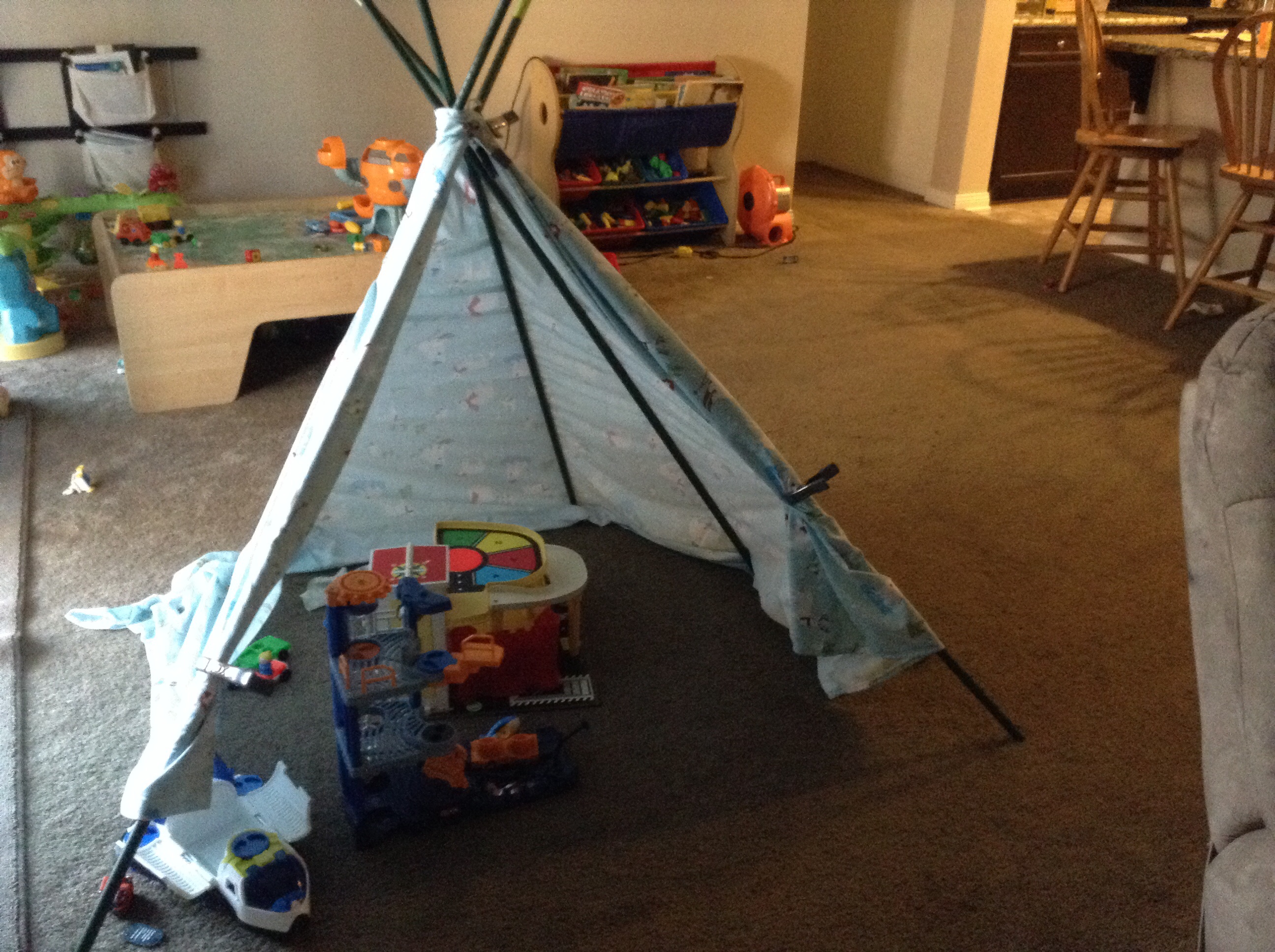
You can recognize the intrapersonal intelligence in young children whenever they tell you they want to do something “by myself” or want to play alone. My grandson, Tigger, is very “self smart”. When he was about three years old, he would discuss the day’s plans with me before he had breakfast. Tigger would tell me what he thought we should have for breakfast, what games we should play, when we should go outside to play, which crafts we should make, go over the lunch menu, his nap, and what television shows he could see after his nap. By the time he was five, he had learned to tell us when he needed to be alone. This usually occurred as soon as he returned home from school, or had been playing with his younger brothers for awhile. To provide for this need, his parents have given him two choices for his “alone  time”: he can play alone in his room, or he can relax in a special “tipi” his parents have improvised for this use in the great room (shown below).

To encourage a child's intrapersonal intelligence, designate or create an area in your home or classroom where children can have some "alone" time.

To encourage a child’s intrapersonal intelligence, designate or create an area in your home or classroom where children can have some “alone” time.

Many elementary school teachers that I have visited have knowingly created special places in their classrooms for quiet reading (a sofa, bean bag chairs, loft, tent, or plump pillows) where their students can get cozy with a book. These are great spaces to encourage a child’s intrapersonal intelligence.

Below I have listed some items, materials, or activities you can use in your home to support the intrapersonal intelligence with the children under your care. As always, remember that many of the supplies can fit into more than one category of intelligence:

special place for “alone time”

materials for their hobbies or interests they can do by themselves

art supplies

writing supplies

construction sets

scrapbooks

picture books

headphones

giving them choices

asking them to talk about their feelings

discussing their goals with them


In the next part of this series, I will present the opposite to intrapersonal intelligence. This would be the “people smart” intelligence or interpersonal intelligence. Remember, according to Howard Gardner’s theory, everyone has their own unique blend of all eight intelligences. That means people aren’t necessarily either intrapersonal or interpersonal. I know many people who are very strong in both of these intelligences, so you can be “people smart” as well as “self smart”.

I’m hoping this series is providing a good overview on The Theory of Multiple Intelligences. In future series I will be explaining how I use multiple intelligence strategies when I teach my grandsons specific concepts. I can’t wait to share with you all of my ideas!


Leave a comment »

Multiple Intelligences in Your Home Part 4

So far in this series I have covered the bodily-kinesthetic, spatial, and musical intelligences. These are part of the original seven intelligences as proposed by Howard Gardner when he first published his book Frames of Mind:The Theory of Multiple Intelligences in 1983.  Gardner added the naturalist intelligence in 1999.

Do you look forward to a summer camping trip, autumn colors in the trees, snow capped mountains, or the first blooms in the spring?  If you have ever embraced the smell of the salty air at the beach, or enjoyed the pine scented fragrance of the forests, you were engaging your naturalist intelligence. I remember how much my 4th and 5th grade students looked forward to the afternoons I would walk them to the park next to our school to read under the trees. We could have stayed in the classroom to read for an hour, but there  was something special about spreading out blankets on the grass and curling up with a good book on a warm spring day.

According to Gardner, people with a strong naturalist intelligence are highly aware of patterns and changes to their environment, and like to relate their learning to the natural world. Nurturing and interacting with plants and animals are very important activities for people who are strong in the naturalist intelligence.

Here are some supplies or activities you could use to encourage the naturalist intelligence in young children:

Taking trips so young children can enjoy the learning experiences in the environment will inspire their naturalist intelligence.

Taking trips so young children can enjoy the learning experiences in the environment will inspire their naturalist intelligence.

Trips to local zoos, parks, orchards, gardens, and outdoor museums

Planting and caring for a garden

Caring for pets

Maintaining bird feeders in your backyard

Playing in dirt, mud, or sand (like building sandcastles)

Lots of time observing plants, animals, insects, etc. in your own outdoor spaces

Books on animals, plants, weather, environments, butterflies, birds, etc.

Supervised use of magnifying glasses, telescopes, cameras, and binoculars

Camping trips to beaches, state and national parks

Park ranger talks

Hiking local trails

Children’s nature videos and television shows (such as “Wild Kratts” and “Octonauts”)

Reading books under a tree


Now that we have covered four of the intelligences, I hope you are seeing that you have most likely already provided many of these materials or experiences for the children in your care. Feel free to share some of your ideas with me too.  I love getting new inspirations.

In the next article in this series I will discuss the intrapersonal intelligence.

Leave a comment »

Multiple Intelligences in Your Home Part 3

In the next installment of this series, the focus is on the musical intelligence.  For most of us, music is an important part of our daily lives. We might wake up to music on our clock/radios, sing in the shower, play music from a cd while driving, hum a song while walking down a hallway at work, or listen to some romantic rhapsodies during a candlelight dinner with our sweetie. Businesses recognize the power of music on our brains too. Most large stores play tunes as you shop, commercials use popular songs to help you remember their product, you hear music on the phone when you are placed on hold, and you probably hear relaxing rhythms while getting a massage.

Music stimulates many parts of the brain including the areas that handle our emotions and memories. It is no wonder that we can remember certain events from our life by recalling the music that was a part of it. We often remember movies by their theme songs. Patients with dementia may not remember their children’s names, but can sing the words to their favorite songs from their teenage years. And music can be a powerful teaching tool as well. I know that if I need to look up the word “ilium” in a dictionary, I need to sing the alphabet song to remember to look after the “h” words. (I always get the order of h, i,  j, and k mixed up otherwise.) So teaching by engaging the musical intelligence is a very powerful strategy.

MUSICAL INTELLIGENCE

People with strengths in the musical intelligence learn, feel, and think through sounds, rhythms, patterns, chants, and melodies. They may be very good at deciphering codes and identifying patterns in many things including numbers. Additionally, those with a strong musical intelligence will spontaneously hum, tap, clap, dance, or whistle songs.


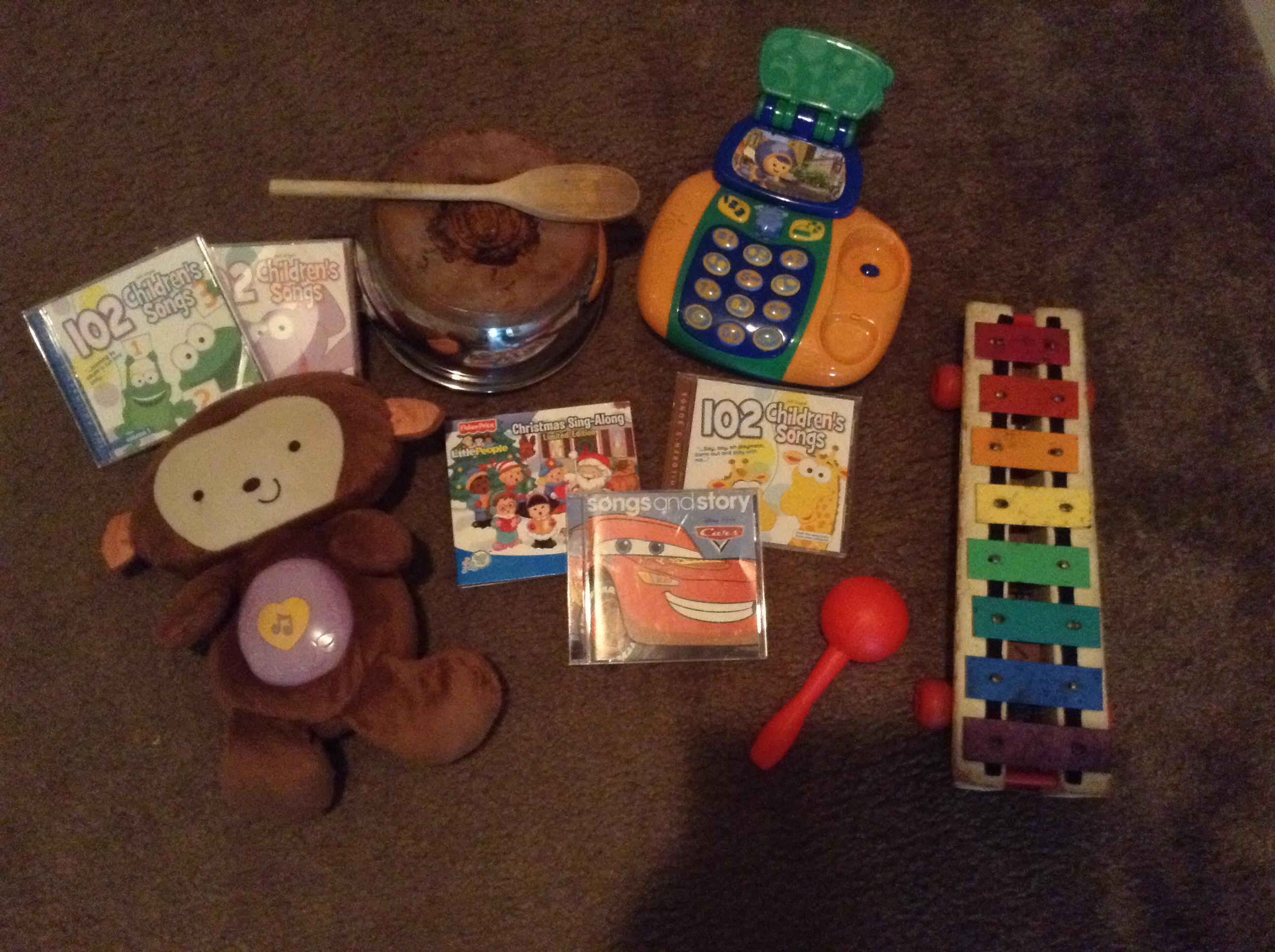
Here are just a few items that can be used to encourage the musical intelligence. Homemade musical instruments (like a pot and wooden spoon) work just as well as purchased instruments.

Here are just a few items that can be used to encourage the musical intelligence. Homemade musical instruments (like a pot and wooden spoon) work just as well as purchased instruments.

Toys, materials, and activities to encourage musical intelligence in young children include:

Simple musical and rhythm instruments (purchased or homemade)

Songs on CDs and tapes

Nature sounds

Background music on the radio

Audiotapes of children’s nursery rhymes or poetry

Singing with or to your child

Videos of songs or finger plays (like “Five Little Monkeys”)

Musical stuffed animals (for naptime)

Books with rhythmic language patterns (like Dr. Seuss)

Toys that play music or sounds (such as toy telephones)


I hope you are finding this series helpful in planning a multiple intelligence rich environment for the children in your lives. Feel free to comment on materials that you use to encourage the musical intelligence.

In the next installment of this series, I will explain the naturalist intelligence.

Leave a comment »

Multiple Intelligences in Your Home Part 2

In the first part of this series I covered the bodily-kinesthetic intelligence. When you see young children trying to climb up your sofa, putting on a cape and mask before zooming around the house, or making “snakes” with Playdoh, they are engaging their bodily-kinesthetic intelligence.

However, when you see children mixing two watercolors together, piecing together Lego blocks to look like the picture on the Logo box, or watching a children’s video on your iPad, they are using their spatial intelligence.

SPATIAL INTELLIGENCE

Children with strengths in the spatial intelligence are attracted to the color, line, and shapes of their environment. Another part of this learning style is the ability to think in pictures and see visual relationships. Allowing young children the opportunity to daydream, manipulate models, and express themselves through art media would be consistent with the spatial intelligence.  Visual presentations such as posters, videos, and demonstrations should also be made available when engaging children through the spatial intelligence.

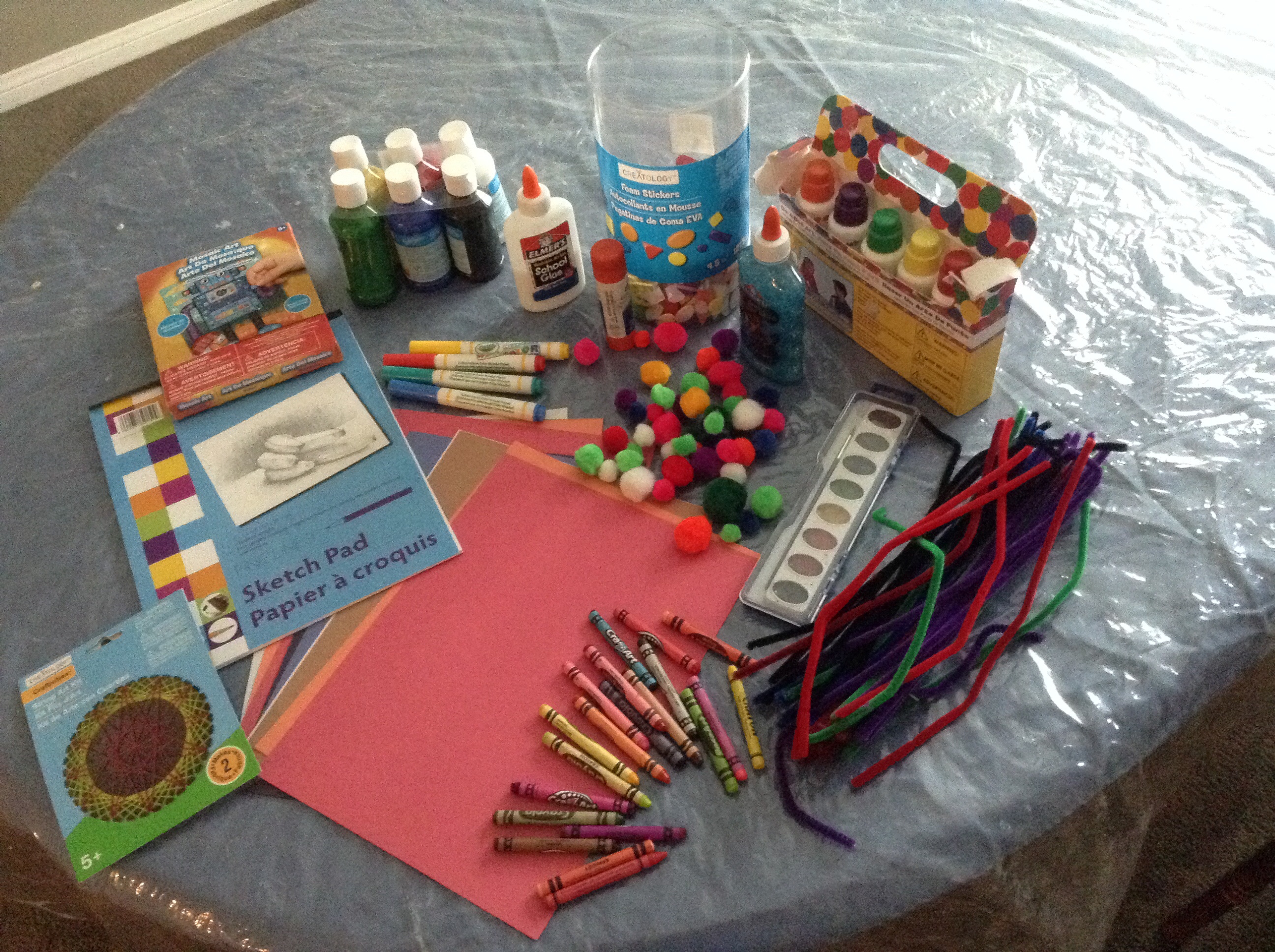
Here are some materials that are provided to my grandsons to encourage their spatial intelligence.

Here are some materials that are provided to my grandsons to encourage their spatial intelligence.

As I begin the list of some items that might be part of an enriched spatial multiple intelligence environment, keep in mind that some items fit into more than one category. For example blocks can be found in spatial (for creating structure and spaces), but blocks also require fine motor coordination so they are additionally bodily-kinesthetic tools.

Here are some ideas for spatial materials:

Drawing utensils such as crayons, markers, and sidewalk chalk

Paper: construction, fingerpainting, sketching, tissue

Paints: fingerpaints, watercolors, temperas, dot paints, brushes

Playdough, slime, modeling clay

Glue stick, glue bottle, glitter glue

Foam board (or precut foam board shapes)

Craft sticks, pipe cleaners, pom-poms, google eyes

Recyclables such as egg cartons, boxes, paper towel rolls

Access to media to see children’s videos, apps, or games

Posters for children (animals, cars, trains, alphabet, numbers and shapes, or anything that interests them)

Puzzles and mazes

Maps and globes (The grands especially love to keep the souvenir maps they get at zoos.)

Construction sets or materials (i.e. Legos)

Model sets to make cars, boats, spaceships,etc.

Art books and craft books

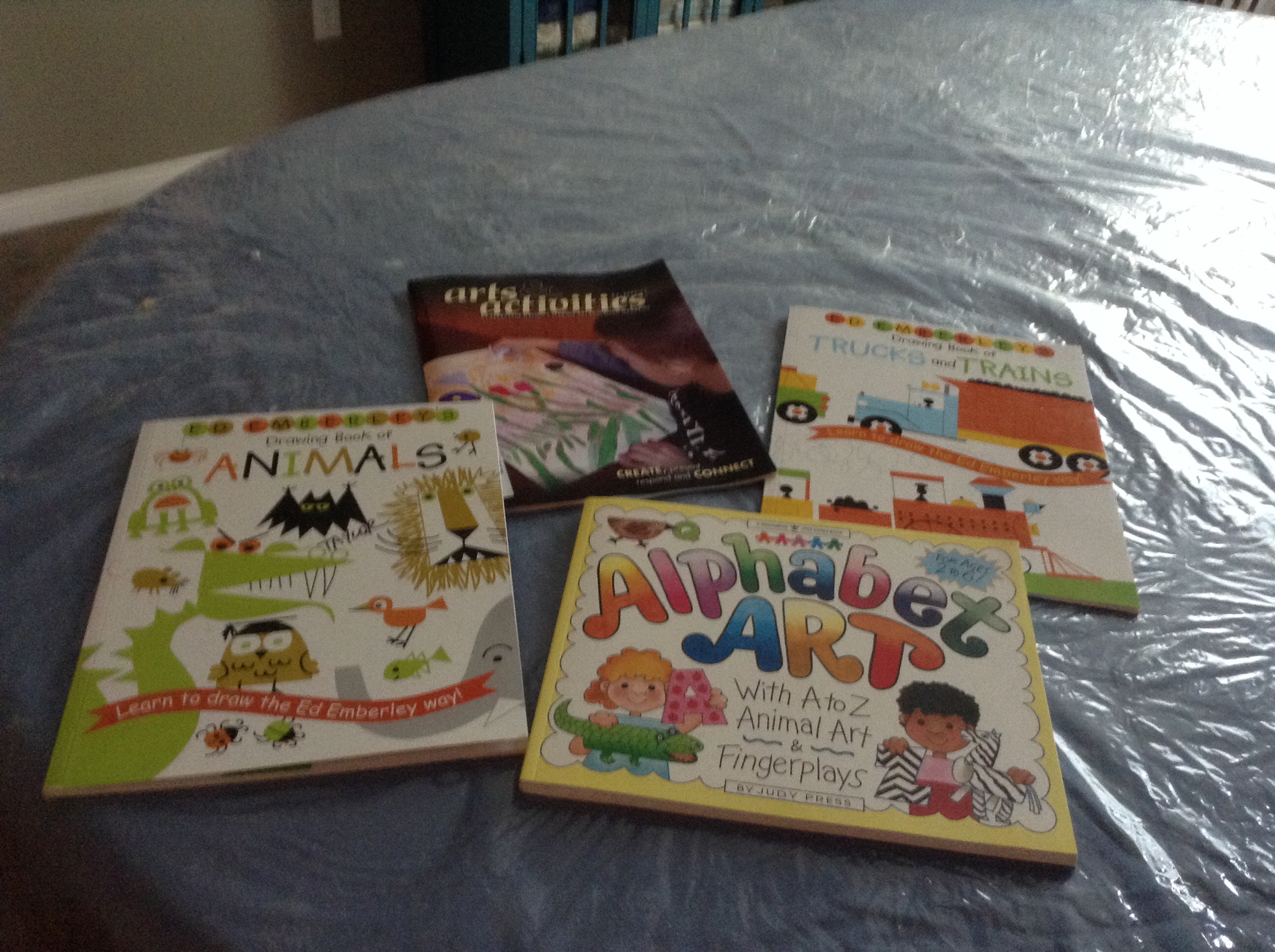
Art books and magazines are also great materials to have available. Since our grandsons are still fairly young, these materials are used by the adults who provide the arts and crafts activities for the grands.

Art books and magazines are also great materials to have available. Since our grandsons are still fairly young, these materials are used by the adults who provide the arts and crafts activities for the grands.

There are so many other materials that could be used to encourage a child’s spatial intelligence. I get new ideas all the time from other bloggers. Feel free to comment on materials that you have found useful.

In the third part of this series, I will cover the musical intelligence.

Leave a comment »

Multiple Intelligences in Your Home Part 1

For young children, learning is not always planned. It just happens….all the time. That is why parents and educators try to create a stimulating environment for children filled with a variety of colorful posters, books, blocks, crayons, and other toys. Spontaneous investigation and play with these materials is extremely important.

In providing an appealing environment for your home (day care room, classroom), why not offer items for each of the eight intelligences? You most likely have done so instinctively, even if you’ve never heard of the Theory of  Multiple Intelligences before reading this blog.

So I am starting a series to highlight some items for young children that would lend themselves to each of the intelligences. This is not an exhaustive list, but should be useful in considering materials you already have or want to get to help children utilize each of their eight intelligences.

I’ll start with a brief overview of each intelligence before listing some components of a multiple intelligence rich environment.

BODILY-KINESTHETIC INTELLIGENCE

This intelligence involves learning through fine and gross motor activities. With this intelligence, people process information through their tactile senses, movement, and expression. Basically any physical activity or hands-on activity would fit into this category.  Creative dramatics such as role playing, pantomimes, and charades are also using the bodily-kinesthetic intelligence.

Keep in mind that many bodily-kinesthetic materials can also be categorized under the other intelligences. For example, crayons are found in the bodily-kinesthetic intelligence (because they contribute to fine motor skills) as well as spatial intelligence (because crayons can create pictures). Toys and other supplies to promote bodily-kinesthetic learning opportunities include:

Some of our bodily-kinesthetic toys and materials.

Some of our bodily-kinesthetic toys and materials.


Playdough, silly putty, and slime

Dry erase boards and markers

Coloring book with crayons and markers

Safety scissors

Lacing and beading toys

Balls of all sizes, including balance balls and nerf balls

Scooters, bikes

Pull toys

Sensory bins 0f rice, beans, pasta, or kinetic sand

Mini trampolines

Dress up clothes and fabric remnants (to create their own fashions)

Blocks, Legos, and other construction sets

Toy cars, trucks, buses, airplanes, helicopters

Toy tools and kitchen utensils

Stacking cups or rings

Sandbox toys

Water table toys, squirt guns, (and bathtub toys for the home)

Plastic containers with lids (could be empty and cleaned yogurt tubs)

Outdoor play equipment such as basketball hoops, swings, slides, climbing ropes

Hula hoops, pool noodles, and jump ropes

Butterfly nets

Musical instruments such as xylophones, drums, and maracas

Play tunnels (could be made from large cardboard boxes)

Puzzles and mazes

Exercise videos for children

Well, this list could go on and on, but you get the idea. Feel free to comment on other bodily-kinesthetic materials you use in your home or classroom for young children.

In Part 2 of this series, I will blog about materials for the spatial intelligence.

Hip Homeschool Moms

2 Comments »

Multiple Intelligences and my Grandsons

Hi, I’m Nancy, also known as “Mimi” to the grands. I’m a former public school teacher who retired to spend more time with my family including watching my three grandsons several days each week. For the sake of their privacy, I will use the names Tigger (8), Kona (6), and Tahoe (4) when I mention them.

Even though I am retired, I still adore teaching, and providing enriching learning experiences for my grandsons is very important to me. Tigger and Kona attend a public charter school and Tahoe attends a local preschool a couple days a week (on the days that I do not watch him). I’m not sure if I would be considered a homeschooler, an afterschooler, or a caregiver. I guess the simplest way to describe my situation is I am still teaching, and my grandsons are the ones I teach.

During my many years of teaching, I was inspired by many professional development workshops and courses. One of the most useful of these teaching strategies was Howard Gardner’s Theory of Multiple Intelligences. In his theory, Gardner proposed that everyone possesses their own unique combination of eight different intelligences (ways of learning). These intelligences are linguistic, logical-mathematical, spatial, musical, bodily-kinesthetic, interpersonal, intrapersonal, and naturalist. Gardner believed that since everyone has a different mixture of these intelligences, it was important that educators include all of these in their teaching to make new learning accessible to all students.

So what does Multiple Intelligences have to do with my grandsons? I obviously want to plan activities for the grands that are going to be engaging to them. Keeping the eight different intelligences in mind as I choose learning experiences for them will ensure that I reach whatever blend of these intelligences my grandsons possess. In other words, I want my grandsons to enjoy the learning process on their way to becoming life long learners.

I hope to share my learning plans and experiences with the readers of my blog. I hope you will drop by again, perhaps to inspire you in your role as a parent, grandparent, caregiver, or educator.


Leave a comment »

Laura Grace Weldon

Free Range Learning, Creative Living, Gentle Encouragement, Big Questions, Poetry, Occasional Drollery

Teach Beside Me

Educate Creatively- Hands-on teaching ideas

P is for Preschooler

Smile! You’re at the best WordPress.com site ever

Life with Moore Babies

Educating Through Multiple Intelligences

about these things

Philippians 4:8

booksandopinions.com

The Book Reviews You Can Trust!

Enchanted HomeSchooling Mom

Educating Through Multiple Intelligences

A Homeschool Mom

Inspiration For Learning and Life.

I Can Teach My Child!

Educating Through Multiple Intelligences

Educating Through Multiple Intelligences

Learn with Play at Home

Educating Through Multiple Intelligences

Learn Play Imagine

Educating Through Multiple Intelligences

Epic Fun for Kids

Educating Through Multiple Intelligences

No Time For Flash Cards

Educating Through Multiple Intelligences

Real Life at Home

printables, worksheets, activities, and crafts for kids

Teaching & Being a Mom

Educating Through Multiple Intelligences

Carrots Are Orange Montessori

Educating Through Multiple Intelligences

The OT Toolbox

Educating Through Multiple Intelligences

Simple Homeschool

Educating Through Multiple Intelligences

Coffee Cups and Crayons

Simple play ideas, learning activities, kids crafts and party ideas, plus acts of kindness for kids!

Playdough To Plato

Empowering teachers with the tools, training, and support you need to help EVERY student learn to read.

The Measured Mom

Educating Through Multiple Intelligences